


From Stamp to Work of Art
01. Sep. 2008
Stamps in Disgrace
Increasing dissatisfaction with the motifs on the Danish stamps was contributory to the change. From the second half of the 1920's and onwards, not only the man in the street, but also artistically skilled people were complaining almost systematically in as well the daily as the specialist press of the inability of the stamps to really tell the surrounding world about Denmark. The postal service should promote the country to a greater extent by showing tourist attractions and at the same time strike a blow for as well agricultural as industrial products.
Criticism was adduced, and examples were presented of how other countries "were able to work it out". Some of the largest Copenhagen newspapers as well as the bulletin for the members of the Draughtsmen's Association held competitions about delivering deserving contributions to improvement of the national stamps. In some cases the winning contributions were forwarded to the Postmaster-General with a recommendation. In the General Directorate of Posts & Telegraphs the criticism was repudiated at first. The postal service was of the opinion that the stamps were well suitable for their purpose with the existing motifs: The wave lines, the regent, and from 1927 also a fine sailing ship. In addition to these, a few commemorative stamps were issued during the years 1925-1930 with other motifs from the real world such as a reproduction of the two first Danish stamps on the occasion of their 75th anniversary, an Aesculapius's snake on a series of stamps sold at an overcharge to the benefit of the Cancer Research Campaign, and an aeroplane over a plough team of two horses on the special airmail stamps. The public should show understanding of the purpose of the stamps: Basically, they were receipts for a service and not actual works of art!
In the long run the management of the postal service was unable to ride out the storm. Even on the Parnassus, the Royal Danish Academy of Art, from which the postal service received artistic advice, the experts realized that renewal was required.
Printing House in Disgrace
In 1930, the postal service got ample opportunity to renew the stamp printing. During the 1920's, the printing house in Copenhagen, which had been printing Denmark's stamps since the beginning in 1851, H.H. Thiele, neglected to keep up with the times and renew their assembly of machinery. Consequently, the company lost orders and its incomes decreased considerably. When it was discovered that the printing house had requested and received advance payments from the postal service on security in the building, the collaboration was discontinued.

Proof from 1936 with stamps of two countries side by side.
Printing of Stamps
The stamp production was moved to the postal service's own workshops on Amager, where already in 1932 a steel engraving rotation machine had been fitted up. The printing technique of the new machine was based on hand-made engravings with fine details which were almost impossible to copy and consequently, the use of watermarked paper was terminated.
The first steel engraved stamps were ready for sale at the post offices on 1st July 1933. Previously used motifs were reused. Commemorative stamps presenting Danish themes were issued only in 1935 when on 1st October three stamps were issued on the occasion of the 100th anniversary of the first publication of Hans Christian Andersen's fairy-tales.
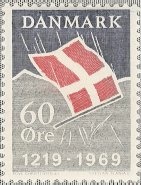
The Danish flag on Denmark´s first three-coloured stamp from 12th June 1969.
Exceptional Proofs
A proof from 1936 shows an attempt to print steel engraved stamps on copperplate printing cylinders. So far the stamps had been embossed in a chromium layer on the printing cylinder, but this was worn down far too quickly. Instead they started to emboss in copper which was subsequently chromium-plated. The chromium layer can be renewed over and over again, and the embossing itself is therefore not worn during printing.
The proof cylinder with two entire sheets consisted of rows of six Danish and two Icelandic stamps, which were perforated as normally for sheets of 100 stamps in the smallest format. The proofs also exist in blue colour and they are supposedly the only proofs in the world with the stamps of two different countries side by side.
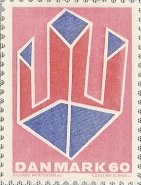
Richard Mortensen's non-figurative stamp was issued on 10th November 1969.
Stamp Art
In 1968, the postal service arranged a competition for drawing Denmark's first three-coloured stamp. Professor Richard Mortensen won with a so-called non-figurative motif which despite great efforts turned out to be impossible to print in an artistically reasonable way. The colours ran together.
The winning stamp should have been issued on 10th April 1969, but it had to be redrawn with "respect zones" of one millimetre in order to avoid that the colours ran together. Consequently, the edition had to be postponed until 10th November 1969 and in the meantime another three-coloured stamp was issued on 12th June 1969. It became the first of its kind, because in Povl Christensen's stamp on the occasion of the 750th anniversary of the Danish flag the colours did not run together.
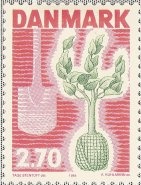
Tage Stentofts frimærke fra 26. januar 1984 for kampag-nen "Plant et træ" er det første danske frimærke trykt med offset. Planten er trykt i stålstik, og der er taget høj-de for at undgå sammen-blanding med offsetfarver-ne.
Tage Stentoft´s stamp from 26th January 1984 for the "Plant a Tree" campaign is the first Danish stamp printed in offset. The plant is a steel engraving and due account has been taken to avoid blending with the offset colours.
Everything is Possible
Since the postal service acquired their latest stamp printing machine in 1981 it has been possible to print Danish stamps in as well steel engraving as photogravure and offset. The machine can even combine all printing methods in the same printing process and in this way produce printed matters in a quality which is matching what is delivered by the National Bank's bank-note printing house. Among other things the photogravure makes it possible to print metal colours like e.g. gold, silver and bronze. In a time when many other countries have abandoned the steel engraving, this printing method still forms the basis of Danish stamp production. It makes falsification almost impossible, and the combination of photogravure and offset gives optimal possibilities of producing stamps of a very high artistic value.
The 75th anniversary is commemorated with an exhibition of all proofs from the four Goebel machines in the stamp cabinet on 3rd floor where also the collections of all Denmark's and Greenland's stamps are on display.
During the course of time the Postal Service has disposed of totally four printing machines, named M1-M4, all purchased from Messrs. Goebel in Germany and with the steel engraving as a basis. Below is an overview of the capacity and duration of the individual machines.
| M1 | M2 | M3 | M4 | |
| In operation | 1932-1982 | 1953-1982 | Since 1968 | Since 1981 |
| Steel engraving | 1 colour | 1 colour | 3, later 6 colours | 6 colours |
| Photogravure | No | 1 farve | No | 1 colour |
| Offset | No | No | No | 4 colours |
This article may be copied or quoted with MuseumsPosten, Post & Tele Museum as source.
Comment this article
Only serious and factual comments will be published.
